Showing posts with label Diesel. Show all posts

5/27/14

Jeep Cherokee Diesel Seen as an Unusual Alternative to the Nissan Qashqai and VW Tiguan


This is one of the first video reviews of the Jeep Cherokee coming from Europe and certainly the first of a diesel-powered model. Auto Express tested a Cherokee fitted with the most powerful diesel engine available, a 2.0-liter unit producing 170PS (168hp) – the Cherokee’s European lineup also includes a 140PS (138hp) 2.0-liter unit.

4/3/14

New BMW 220d Has a Lot to Offer, Review Finds Out


If you want a BMW 2-Series, the engine you go for will dictate the character of the car, which you can then further refine by fitting it with one of the available styling packs. There’s definitely plenty of choice in its range, and plenty of available diversity (at least in Europe), but which model will be the most popular?

This Polish Jaguar XJ Runs on a 1.8-liter Ford Diesel


I don't know how many of you agree, but I find Jaguar's XJ40 series (built from 1986 to 1994) as one of the brand's better styling moments in the segment. Of course, that has nothing to do with what the previous owner of this 1990 Jaguar XJ did to his/her car.

4/2/14

Today’s Diesels are Considerably Cleaner and Greener than 10 Years Ago, Notes SMMT Study


The UK’s Society of Motor Manufacturers and Traders (or SMMT for short) has compiled a report from which the conclusion was drawn that modern diesels are a whopping 21 percent cleaner than in 2003, in terms of tailpipe emissions, while the actual progress in efficiency is even higher: a 27 percent recorded improvement.

11/29/13

New DI Gasoline Engines Said to Emit 1,000 Times More Harmful Particles than Older Ones


Automakers say that downsizing is the only way to go in order to comply with ever stricter fuel emissions regulations. This is true when it comes to CO2 emissions, but it looks like there are far more poisonous gases that the new-generation of turbocharged engines with direct injection emit into the air we breathe.

According to a study by independent technical research institute TÜV Nord, new-generation petrol engines typically release around 1,000 times more harmful particles, including carcinogens, than traditional designs, and 10 times more than new diesel engines.

This is shocking information, to say the least, especially since carmakers claim that gasoline direct injection petrol engines have helped them dramatically reduce emissions.

The study, which was seen by the Financial Times, refers to particles classified by the World Health Organization as harmful, including carcinogens, substances that are believed to cause cancer.

The explanation for this is that new-generation gasoline engines operate with higher pressure in their cylinders to reduce emissions, but in doing so, they produce larger numbers of the particles. European regulations require filters that stop particle emissions to be fitted to all new diesel cars, but there is no similar condition for gasoline engines. A diesel particulate filter costs as little as €50 ($68).

According to EU research, air pollution is directly responsible for 406,000 deaths each year, causing causes more than 100 million lost days of work – that translates into losses for the EU economy of more than €330 billion ($448 billion).

Whether we like it or not, cars are the largest source of air pollution in European cities – but a significant part of that pollution can be eliminated if solutions to limit emissions of particles were applied to new-generation gasoline engines as well.

By Dan Mihalascu


PHOTO GALLERY

Kia-Ceed-GDI-engineVW-TSI-engine

11/28/13

VW Surprised by the Popularity of its Diesel Models in the U.S.


Volkswagen of America CEO Jonathan Browning said he’s surprised by the rate Americans are adopting diesel-powered models. Volkswagen is the market leader in the light-duty diesel vehicle segment in the U.S., holding a 72 percent market share - the equivalent of about 90,000 cars per year.

In the first ten months of this year, diesel vehicles made up 22 percent of Volkswagen of America’s total sales, far exceeding the company’s expectations. As the first diesel model in the U.S. mid-size sedan market, the VW Passat TDI had a key contribution to this result.

VW worried that customers may not only be reluctant to diesel, but to the brand as well, as it had to conquest a lot of customers from competitors. “We thought the step to convert them to the Volkswagen brand was going to be a fairly substantial step in itself, and then it would be an even bigger step to convert to diesel,” Jonathan Browning was quoted as saying by Autocar.

Browning added that diesel models suit American driving habits and the fuel economy they deliver is just incredible for consumers.

“In fact, because it is such a compelling offer – almost 800 miles range, and with the typical US driving profile, it is possible to get even better-than-published fuel economy with the diesel because there’s a lot of highway driving – customers are just raving about it,” the executive added.

VW originally expected 17 percent of Passat sales to be diesels, but the Passat TDI’s share is getting closer to 30 percent.

By Dan Mihalascu


PHOTO GALLERY

VW-Passat-TDI-US-1VW-Passat-TDI-US-2VW-Passat-TDI-US-3VW-Passat-TDI-US-4VW-Passat-TDI-US-5

11/27/13

2M-Designs Will Have Your Jaguar XF Diesel Looking Like This for €15,000


Not that the Jaguar XF lacks in the style department, but German foil wrap specialist 2M-Designs has collaborated with local tuners Loder1899 and MB-Individual Cars to present a more unique and powerful take on the British luxury saloon.

The makeover of the diesel-powered XF 3.0 SDV6 begins with a silky matte white foil wrap and black accents before a rear diffuser made out of carbon fiber and several elements from the XFR-S are added, including the front bumper, grille and bonnet scoops.

Completing the look is a set of 21-inch wheels shod in 255/30ZR21 tires on the front axle and 295/35ZR21 on the rear, and slightly tinted head- and tail-lamps.

The XF also gains a 35mm lowered sports suspension with Eibach parts and an engine tune that includes a different exhaust system boosting the 3.0-liter V6's output from 275PS (271hp) to 340PS (335hp) for a 0-100km/h (62mph) sprint time of 5.4 seconds and a top speed of 280km/h (174mph).

The cost for this specific build in Germany is €15,000, which comes to around US$20,400 at the current exchange rates.


PHOTO GALLERY

JAGUAR XF_ 2M-Designs_1JAGUAR XF_ 2M-Designs_2JAGUAR XF_ 2M-Designs_3JAGUAR XF_ 2M-Designs_4JAGUAR XF_ 2M-Designs_5JAGUAR XF_ 2M-Designs_6JAGUAR XF_ 2M-Designs_7JAGUAR XF_ 2M-Designs_8JAGUAR XF_ 2M-Designs_9JAGUAR XF_ 2M-Designs_10

11/15/13

VW Recalling 2.6 Million Cars Globally Including 850,000 in China


Volkswagen has announced it is recalling approximately 2.6 million cars worldwide, a third of which are in China. The company said 800,000 Tiguan vehicles worldwide, including 147,000 in Germany, built between the beginning of 2008 and the middle of 2011, are recalled because a fuse may trip and cause one of the two vehicle light circuits to fail. This in turn would cause individual light functions to fail.

According to VW, replacing the fuse with one with a tougher surface coating only takes a few minutes, with affected vehicle owners to be informed by the company accordingly.

The carmaker also announced it is recalling 239,000 Amarok pick-ups globally (12,359 in Germany) built between the vehicle’s launch and June 2013. That’s because “some Amarok pick-ups with a 2-litre TDI engine may be affected by leaks to the fuel pipe within the engine compartment,” VW said. To avoid any accidental damage to the fuel lines a chafe protector will be fitted at the affected points as part of the recall action.

Besides the Tiguan and Amarok, VW said it will request all owners of VW Group cars with a 7-speed dual-clutch gearbox (DQ200) filled with synthetic oil to visit a workshop for an oil exchange. Around 1.6 million vehicles are affected by this recall, most of them located in China (640,309 cars) and Southeast Asia. Furthermore, 207,778 Tiguans will be recalled in China as well.

VW has discovered that on cars with the 7-speed DSG “electric malfunctions could occur in the gearbox power supply if synthetic gearbox oil is used.” That happens particularly if the vehicle is subject to a hot and humid climate, coupled with a high proportion of stop & go driving, VW added.

The remedy is to replace the synthetic oil with mineral oil. Models affected by this recall in China are imported VW cars like the Scirocco, Golf Variant, Golf Cabriolet and Beetle, as well as locally built models with FAW and SAIC Motor, including the Bora, Golf, Sagitar and Magotan, Touran, Lavida, Superb, Octavia, Passat and Polo.

By Dan Mihalascu

Story References: VW via Reuters


PHOTO GALLERY

2013-VW-Amarok-12013-VW-Amarok-22013-VW-Amarok-32013-VW-Amarok-42013-VW-Amarok-5DB2011AU00187DB2011AU00190DB2011AU00203DB2011AU00185DB2011AU00186

Mazda to Enter Diesel Racer for Inaugural United SportsCar Championship in 2014


The United Sports Car Championship is, as its name states, a sports car racing series that was originally announced in March of this year, being peppered with details until its 2014 debut was also announced. It’s set to take place on tracks from both the US and Canada and have its entrants split into four distinct classes: Prototype (P), Prototype Challenge (PC), GT Le Mans (GTLM) and GT Daytona (GTD).

Now, Mazda has officially confirmed its participation, in the Prototype class, where it plans to use two SKYACTIV diesel-powered racers whose engines will be very closely related to those used in their road cars.

“The SKYACTIV-D Smart Diesel race engine is a true production-based engine and a carry-over from the development work done with the Mazda6 GX-class racing cars," says the Japanese company."The engine is 51 percent stock by parts count, and 63 percent stock by weight.  Mazda chose this path as it is the most honest way to demonstrate the performance, quality, durability, and reliability of Mazda powerplants.”

The cars are expected to make their public debut, at the “Roar before the 24” testing session between January 3-5.

However, the Japanese manufacturer is also officially looking into modifying its successful (and nice looking) 6 sedan diesel racer into a GT Daytona class car, though that ambition was not fully detailed in the supplied press release.

By Andrei Nedelea


PHOTO GALLERY

MAZDA NORTH AMERICAN OPERATIONS 2014 SKYACTIV-D PROTOTYPE RACER

11/14/13

Gasoline-Powered Cars Twice as Likely as Diesels to Fail UK’s MOT Emissions Tests, Study Finds


Recent MOT test data from the United Kingdom shows that excess exhaust emissions levels account for more than a quarter (26.2 percent) of all MOT failures. What’s more interesting is that, petrol (gasoline) cars more likely to fail meeting the required emissions standards (9.7 percent) than diesel-engined cars (3.9 percent).

So why is there such a big difference between petrol and diesel cars? “There are a number of possible explanations for the marked difference in MOT emissions failure rates between petrol and diesel cars,” explains Bruce Ellis, research and development manager at Redex, a maker of additive products that evaluated the data that is submitted to the Vehicle Operator and Services Agency (VOSA) by every MOT test facility in the UK.

“These include the different driving cycles that traditionally are undertaken.  Namely, petrol cars are more likely than diesels to be chosen for frequent shorter, urban trips, whereas diesels are more likely to be chosen if the vehicle is to be commonly used for longer, motorway-based journeys.  Also, diesels operate at lower engine speeds and are therefore a little less stressed than higher revving petrol motors,” Ellis says.

However, while these factors do make a difference, the biggest one is the MOT test itself, he adds.

“Petrol cars are assessed for a high number of gases and hydrocarbons in the exhaust emissions, while diesels are tested only for smoke levels. This means that relatively speaking, diesels probably have an easier emissions test than petrol-engined cars,” Ellis explains.

That may be happening now, but the future doesn't sound so good for diesels.

Analyzed data covers 47.97 million MOT tests taken during the full year of 2010 and the first nine months of 2011.

By Dan Mihalascu


11/13/13

VW Golf TDI BlueMotion Averages 2.92L/100 KM (80.5MPG US) in 1,602KM Trip across Europe


Volkswagen has taken the Golf TDI BlueMotion for a 1,602-km (995-mile) trip from Nantes, France, to Copenhagen (Denmark) to demonstrate the fuel economy of the most frugal Golf model. The test run called “Think Blue. Eco Ride.” was supervised by vehicle inspection company DEKRA and consisted of a trip from Nantes to Copenhagen without refueling.

The Golf TDI BlueMotion managed to cover the entire distance on a single tank of fuel, posting an average fuel consumption of 2.92 l/100 km (80.5 mpg US).

This figure was reached in normal traffic over a driving time of 20 hours and 45 minutes. The standard 50-liter fuel tank was filled in Nantes, where it was sealed by a DEKRA inspector. At the end of the trip, 46.92 liters of diesel were filled into the same tank under the supervision of the same inspector.

The route chosen by VW led from Nantes, the “European Green Capital 2013”, via Paris, Antwerp, Bremen and Hamburg to Copenhagen, the “European Green Capital 2014”.

The fuel economy result is below the Golf TDI BlueMotion's standard consumption figure based on the NEDC driving cycle of 3.2 l/100 km (73.5 mpg US). Powered by a 1.6-liter turbodiesel engine developing 110PS (108hp) and 250 Nm (184 lb-ft) of torque from as low as 1,500 rpm.

Aside from the frugal diesel engine, the Golf TDI BlueMotion also features a standard start-stop system and regenerative braking mode. In addition, fuel economy is boosted by the car’s improved aerodynamics, lower weight, modified six-speed manual gearbox and low rolling resistance tires.

By Dan Mihalascu


PHOTO GALLERY

DB2013AU01395DB2013AU01394

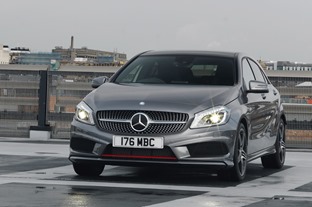
New ECO-Versions of Renault-Powered Mercedes A180 and B180, Plus AWD Option for Both Series


Mercedes-Benz is refreshing its UK lineup of A-Class hatchbacks and B-Class small MPVs with the introduction of new ECO versions and the addition of AWD editions for both models.

Available from January 2014, the new A 180 CDI ECO SE and B 180 CDI ECO SE replace the regular A 180 CDI and B 180 CDI.

They combine the Renault-sourced 109bhp 1.5-liter turbo diesel with a series of fuel-saving measures that include the use of an aerodynamic grille element, underbody paneling and lowered suspension (-10 mm front and 15 mm rear for A-Class, and 20 mm at the front and 15 mm at the rear for B-Class). They also feature manual gearboxes with longer ratios in the higher gears, an improved energy recuperation system and a lighter fuel tank

Mercedes says that compared to the standard A 180 CDI, CO2 emissions have been reduced by six per cent to 92 g/km, with combined fuel consumption increased to 78.5 mpg UK (versus 74.3 mpg on the outgoing model). On the B 180 CDI ECO SE emissions were reduced to 98 g/km CO2 or nine percent, while fuel economy jumped eight per cent to 74.3 mpg UK.

Despite the economy gains, Mercedes states that power, torque, top speed and 0-60 mph acceleration, remains unchanged for both models.

Along with the new ECO variants, Benz is introducing the four-wheel drive system first seen on the CLA 250 4MATIC, on both the A- and B-Class, again from January 2014. In particular, the A 250 4MATIC will be available in both AMG Sport and Engineered by AMG trim, while the the B 220 4MATIC, exclusively in Sport trim.

In terms of pricing, the A 180 CDI ECO SE will start from £21,965 on the road, the B 180 CDI ECO SE from £22,950 OTR, the A 250 4MATIC from £28,985 OTR for the AMG Sport trim and £30,905 for the Engineered by AMG trim, and the B 220 4MATIC, at £28,135 OTR.


PHOTO GALLERY
Mercedes-1Mercedes-2

11/12/13

2014MY Opel Astra Gets New 1.6-Liter CDTI Diesel Engine, Averages 3.9 L/100 KM


A year after the first facelift of the Astra family, Opel has introduced the new generation 1.6-liter CDTI diesel engine on its core C-segment model.

Launched on the Zafira Tourer, the Euro-6 compliant powerplant develops 136PS (134 hp) and 320 Nm (236 lb-ft) of torque.

Fitted with a standard start-stop system, the unit delivers an average fuel economy of 3.9 l/100 km (60.3 mpg US) on the Astra, 7 percent less than its 1.7-liter predecessor (130PS/128hp). CO2 emissions are rated at 104 g/km.

Opel says the new engine is quieter than the unit it replaces and that it offers better acceleration as 0 to 100 km/h (62 mph) takes 10.3 seconds, while 80 to 120 km/h (50 to 75 mph) in fifth gear, 9.2 seconds. Top speed is 200 km/h (124 mph).

The diesel engine is available to order on the Astra five-door hatchback, the Astra sedan and the Astra Sports Tourer wagon, but not yet on the Astra GTC.

Besides the new diesel engine, the 2014MY Astra also gets the IntelliLink infotainment system with Bluetooth interface, originally available only on the Insignia. The technology integrates smartphone functions into the car, with Opel saying it is easily controllable and clearly arranged on a seven-inch high-resolution color display. IntelliLink will be rolled out on more Opel models in the future.

Finally, Opel also offers a new Active- option pack, which includes features such as LED daytime running lights, CD 600 IntelliLink system, Aux-In-, USB- and hands-free equipment via Bluetooth interface, as well as Piano Black Décor Moldings in the cockpit.

By Dan Mihalascu


PHOTO GALLERY

Opel-Astra-1Opel-Astra-2Opel-Astra-3Opel-Astra-4Opel-Astra-5Opel-Astra-6Opel-Astra-7Opel-Astra-8

Related Posts Plugin for WordPress, Blogger...

Recent Post

free counters